The Key Drivers Behind the Next Generation of Marine Fuels
By: Nicole Gotthardt, Berta Lascuevas Laguna, & Huck Agar Johnson
The background image at the top of this article belongs to Lloyd Register.
With no single alternative fuel capable of fully replacing conventional marine fuels today, how are shipping companies deciding which fuel to invest in?
As the maritime industry moves from setting climate targets to implementing them, shipping companies must decide which fuel, or combination of fuels, best suits their vessels, routes, and investment strategies. In this post, we explore the key drivers behind decarbonization decisions and compare the leading alternative marine fuels.
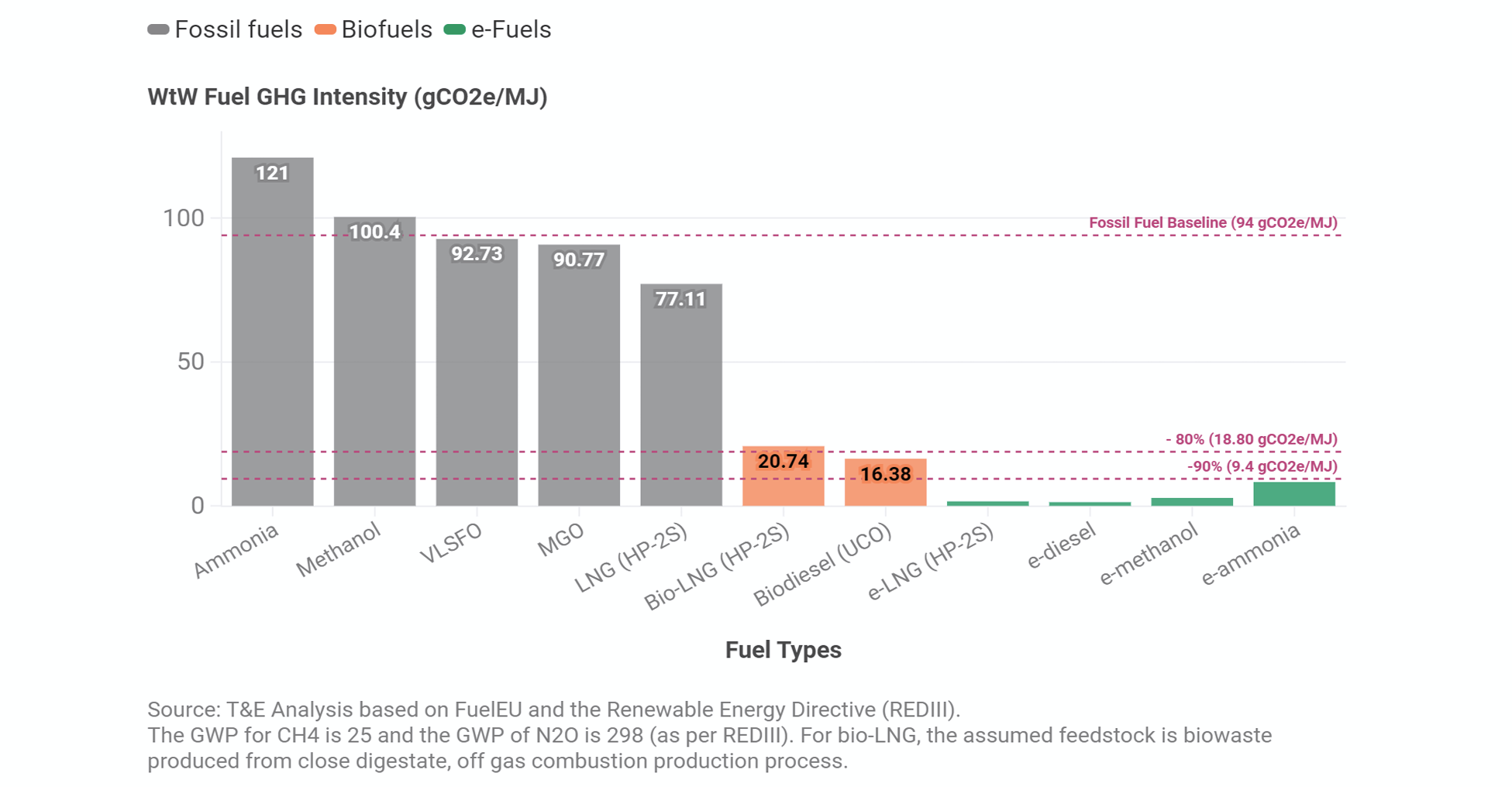
Today, maritime shipping is dominated by high carbon intensity (CI), oil-based conventional fuels, including heavy fuel oil (HFO), low-sulfur fuel oil (LSFO), marine gas oil (MGO), and marine diesel oil (MDO). Lower-carbon alternative fuels are needed to meet increasingly stringent maritime decarbonization regulations adopted by the EU and proposed by the IMO. The leading alternatives under consideration include renewable drop-in fuels, liquefied natural gas (LNG), methanol, ammonia, and hydrogen. Each fuel offers a distinct CI, cost, and technology readiness profile. Under current and proposed regulations, the carbon intensity of marine fuels must decline by approximately 6–20% by 2030 and around 80% by 2050 compared to a 2008 baseline, making lifecycle greenhouse gas performance an increasingly important consideration in fuel selection (see chart below).[1]
While decarbonization policies play a critical role in driving demand for cleaner alternatives, the pace of the sector’s transition will ultimately depend on the availability, scalability, and cost of alternative fuels.
See our previous post here for a look at the International Maritime Organization (IMO) and European Union (EU) regulatory frameworks driving this transition, and our Methane-to-Methanol project page for more on our current work.
Potential Carbon Intensity Values of Alternative Marine Fuels Compared to Fossil Counterparts
Drivers Impacting Fuel Choice
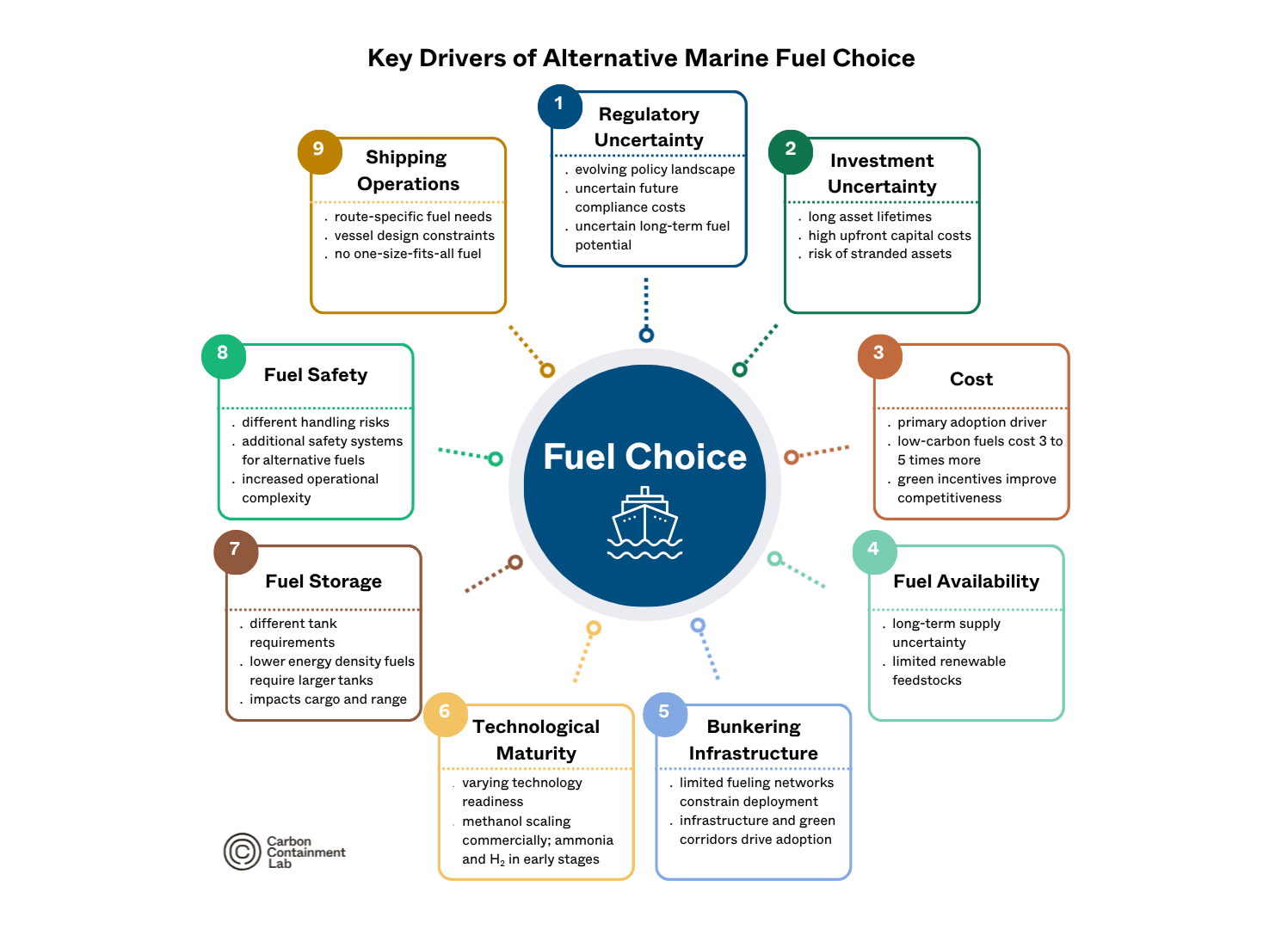
In the wake of global decarbonization efforts, shipping companies must make long-term investment decisions for their fleets under considerable uncertainty. We identified nine interrelated factors that collectively shape fuel choice:
Regulatory uncertainty
Investment uncertainty
Cost
Fuel availability
Bunkering infrastructure
Technology maturity
Fuel storage
Fuel safety
Vessel-specific operational requirements
Together, these factors determine which fuels are both technically feasible and commercially viable over a vessel's 20–30-year lifetime.
Carriers currently prioritize decarbonization on routes already supported by regulatory and market incentives, particularly within green shipping corridors (GSCs) or at European ports. As the proposed IMO Net-Zero Framework will potentially expand decarbonization requirements globally, shipowners face several strategic decisions: whether to decarbonize through alternative fuels or rely on operational efficiency improvements and remediation units; whether to retrofit existing vessels or invest in new builds; and ultimately, which fuel pathway is most likely to remain competitive over the coming decades.
Marine Fuel Choice Depends on Nine Key Drivers:
1) Regulatory Uncertainty
Today's fuel decisions are based on tomorrow's regulations. Evolving international and regional decarbonization policies—including carbon pricing, fuel-intensity calculation methodologies, emissions standards, and fuel regulations—can significantly alter the long-term potential of alternative fuel pathways.
2) Investment Uncertainty
Choosing the wrong fuel pathway can lock shipowners into decades of financial risk. Vessels typically operate for 20–30 years, requiring investment decisions long before markets, technologies, infrastructure, and regulations have fully matured. High capital expenditures for newbuilds, dual-fuel engines, fuel storage systems, and retrofits increase the risk of stranded assets if fuel pathways fail to achieve widespread adoption or if policy support changes. For example, in this current moment of uncertainty for the passing of the IMO Net Zero Framework, many shipowners are delaying investments, pursuing fuel-flexible technologies, or diversifying their fuel portfolios while monitoring the evolving regulatory and market landscape.
3) Cost
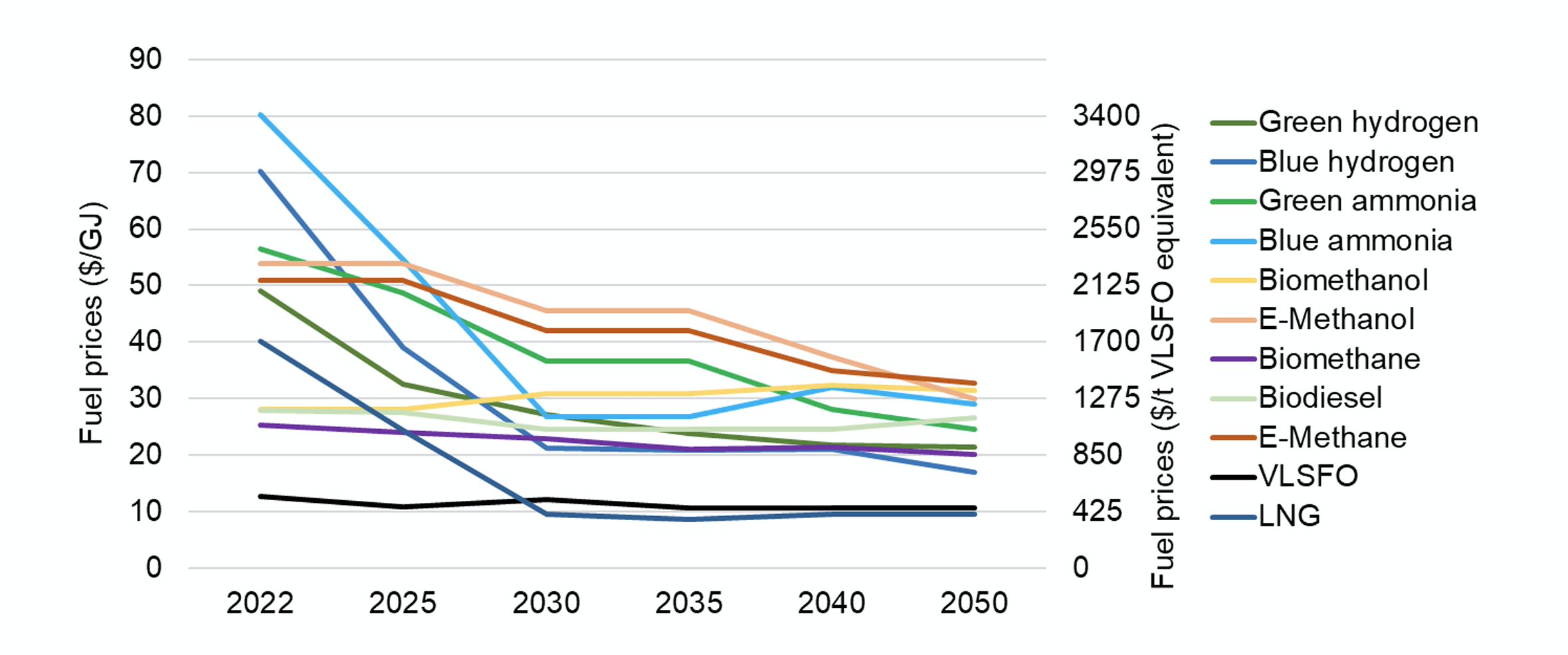
Cost is the primary determinant of alternative fuel adoption. Shipowners are highly sensitive to both fuel prices and the capital costs associated with newbuilds, retrofits, and onboard fuel systems. Low-carbon marine fuels currently cost approximately three to five times more than conventional fossil-based marine fuels (roughly $1,500–3,000 vs $550–650 per metric ton, respectively), with prices influenced by production pathway, feedstock availability, distribution costs, economies of scale, and policy incentives.[2] Alternative marine fuel costs are projected to decline over time (see chart below), but considerable uncertainty remains regarding the magnitude and pace of these cost reductions. As fuel accounts for 50–80% of a vessel's operating expenses, strong policy incentives and carbon pricing mechanisms are often needed to offset these ongoing high costs and create the business case for green fuels.[3]
4) Fuel Availability
Long-term fuel availability is essential for investment decisions. Shipping companies require confidence that sufficient quantities of low-carbon marine fuel can be produced at scale and remain competitively priced throughout a vessel's lifetime. The future fuel supply of renewable fuels is constrained by feedstock availability, renewable electricity, captured carbon dioxide (CO₂), and competition from other hard-to-abate sectors. Achieving the IMO's 2030 target of a 20% reduction in shipping emissions will require an estimated 25 million tons oil equivalent (MToe) of low-GHG fuels annually, a 25-fold increase from the approximately one MToe of low-GHG fuels consumed by the maritime industry today.[4]
5) Bunkering Infrastructure
The availability of bunkering facilities and fuel supply infrastructure strongly influences adoption. Bunkering is the process of supplying and transferring marine fuel to a vessel for storage and use by its propulsion and onboard power systems. Limited bunkering infrastructure restricts operational flexibility and increases investment risk, while mature infrastructure networks enable broader adoption and reduce uncertainty for shipowners. Although green shipping corridors are helping concentrate infrastructure investment, the limited availability of bunkering facilities for emerging fuels continues to constrain widespread adoption.
6) Technology Maturity
The commercial readiness of propulsion technologies determines how easily alternative fuels can be adopted. Mature technologies, such as biodiesel and LNG engines, are readily available with low risk, whereas methanol engines are still scaling commercially, and ammonia and hydrogen propulsion remain at earlier stages of development.
7) Fuel Storage
Fuel storage requirements directly affect vessel design, cargo capacity, and operating range. Alternative fuels differ substantially in volumetric energy density, requiring different storage volumes and tank designs. Fuels with lower volumetric energy density require larger onboard storage systems, reducing available cargo space and limiting vessel range. Consequently, fuels with higher volumetric energy density are generally preferred for long-distance shipping.
8) Fuel Safety
Safety is an important consideration in fuel adoption, influencing vessel operations, crew training, and regulatory compliance. Fuels with greater handling risks—in particular, ammonia and hydrogen—require additional safety systems, operational procedures, and emergency response capabilities, increasing operational complexity and implementation costs.
9) Shipping Operations
Operational requirements determine which fuels are suitable for different vessel types and routes. Factors such as voyage length, refueling frequency, cargo capacity, engine power, and port accessibility influence fuel selection, meaning that no single alternative fuel is optimal across all shipping applications.
Forecast Prices of Fossil and Alternative Marine Fuels through 2050
Alternative Marine Fuels Overview
Each alternative marine fuel offers a distinct combination of environmental performance, cost, technical maturity, operational characteristics, and scalability. No single fuel performs best across every decision criterion. Instead, each fuel offers a different balance of near-term deployability and long-term decarbonization potential. Most alternative-fuel vessels entering service today are dual-fuel ships, with specialized engines capable of operating on both conventional marine fuels and a lower-carbon alternative. Dual-fuel capability reduces investment risk by allowing operators to transition gradually as fuel availability and regulations evolve.
.png)
Comparison of Alternative Marine Fuels
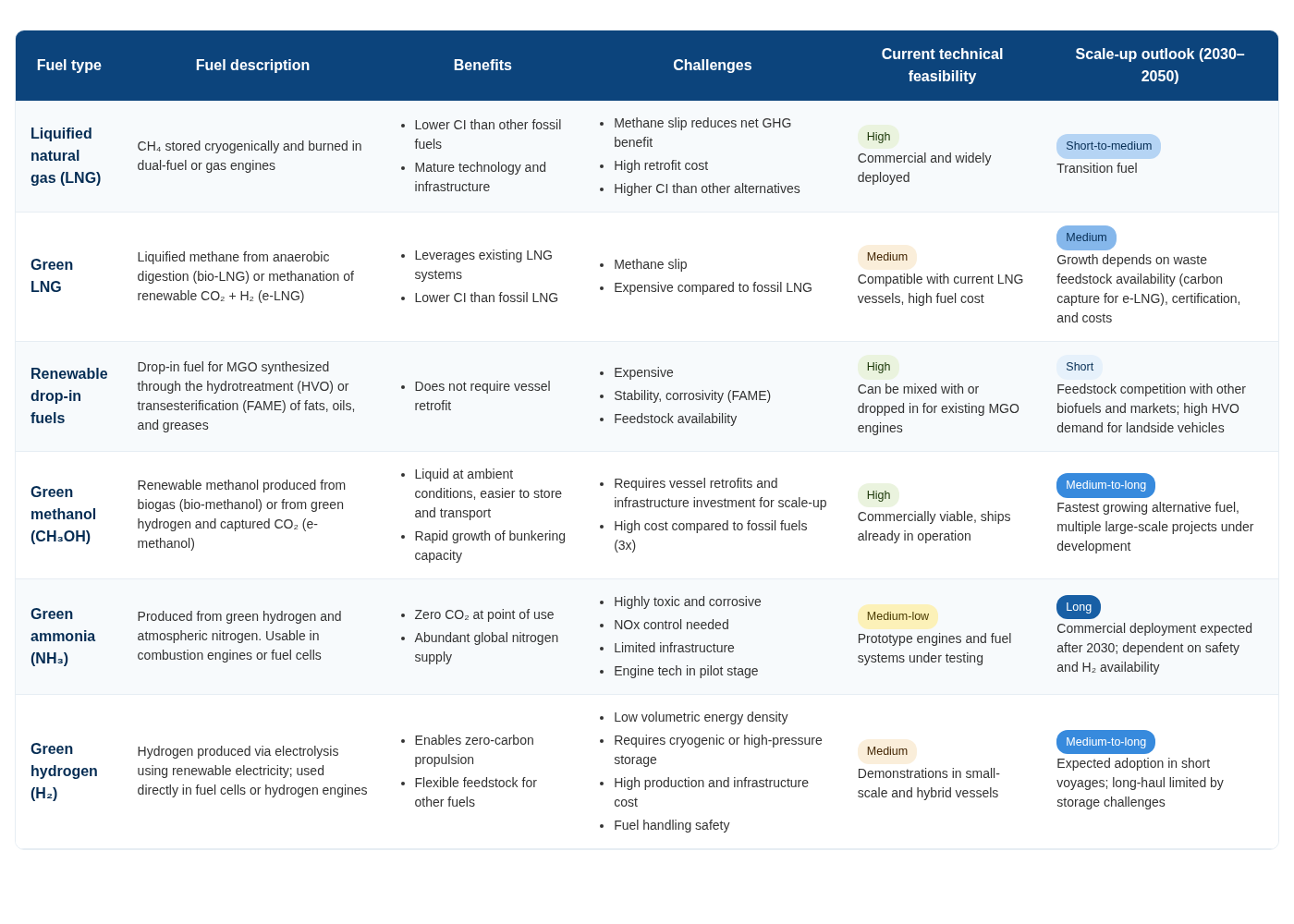
Renewable Drop-In Fuels
Renewable drop-in fuels—including hydrotreated vegetable oil (HVO) and fatty acid methyl ester (FAME), collectively referred to as biodiesel—offer one of the simplest pathways for reducing lifecycle emissions because they can be used with existing engines and bunkering infrastructure. These fuels have a significantly lower carbon intensity compared to conventional marine fuels, with an estimated CI of 16.38 grams of carbon dioxide equivalent per mega-joule (g CO2e/MJ).[1] However, their long-term deployment is constrained by sustainable feedstock availability and production capacity.
HVO is a true drop-in fuel replacement for marine gas oil (MGO), produced through the hydrotreatment of fats, oils, and greases (FOGs). It is chemically stable and has a similar flashpoint to MGO, although its lower density, viscosity, and lubricity may require blending or additive adjustments to maintain fuel injection performance and minimize wear on pumps and injectors.
FAME—also synthesized from FOGs—is commonly blended with MGO, but is not a true drop-in fuel. Its lower energy density, instability (susceptibility to oxidation and water absorption), and potential corrosivity toward certain elastomers and metals limit blending ratios and reduce long-term storage stability.
Despite these advantages, biodiesel pathways face scalability constraints because they rely on sustainable biomass feedstocks, which are also in high demand from other hard-to-abate sectors. In particular, the aviation industry is expected to compete strongly for these feedstocks to produce sustainable aviation fuel (SAF), potentially limiting biodiesel availability for maritime applications.
LNG
LNG is currently the most dominant alternative marine fuel in the shipping sector. LNG-capable dual-fuel vessels account for 7.8% of the global fleet’s gross tonnage (a measure of a ship’s total internal volume) in operation and dominate the order book, representing 36.8% of the total tonnage on order and 72% of the alternative fuels gross tonnage on order.[4] Its rapid deployment has been enabled by commercially mature dual-fuel engine technology, an established global supply chain, and approximately 222 bunkering facilities worldwide, compared to the over 1,000 bunkering ports for conventional fuels.[6] Compared with HFO, LNG has a lower lifecycle carbon intensity of approximately 77 g CO₂e/MJ and significantly reduces sulfur oxide (SOₓ) and nitrogen oxide (NOₓ) emissions.[1] However, LNG requires cryogenic storage systems, increasing vessel complexity, insulation requirements, energy use, and capital costs.
While LNG has a lower CI than conventional marine fuels, it is insufficient to meet long-term decarbonization targets and is therefore not considered a low-carbon fuel. Consequently, fossil LNG is generally regarded as a transition fuel, with its relatively low cost and established supply chains supporting widespread adoption. The greatest challenge associated with LNG is methane slip, where unburned methane released during fuel production, transportation, and combustion offsets a portion of its climate benefits. Methane slip from incomplete combustion alone typically ranges from 3–6% of fuel consumed in the dominant low-pressure dual-fuel (LPDF) engines. While regulators assume methane slip rates of 3.1% (EU FuelEU) and 3.5% (IMO),[7] real-world measurements of the most common LPDF four-stroke engines average 6.4%.[8] Assuming a 4% methane slip and an LNG lower calorific value of 49.1 MJ/kg, the effective well-to-wake carbon intensity of LNG increases from 77.11 to approximately 99.9 g CO₂e/MJ using a 100-year global warming potential (GWP-100) and 145.5 g CO₂e/MJ using GWP-20, representing increases of approximately 30% and 89%, respectively.[9], [1]
Renewable LNG can substantially reduce lifecycle greenhouse gas emissions while utilizing existing infrastructure developed for fossil LNG. Bio-LNG, produced from biogenic methane, and e-LNG, synthesized through the methanation of renewable hydrogen and captured CO₂, can achieve carbon-neutral or even carbon-negative emissions depending on feedstock and production pathways. Although renewable LNG remains significantly more expensive than fossil LNG, bio-LNG is generally more cost-competitive than synthetic e-LNG, as it avoids the high energy requirements of renewable hydrogen production. However, its long-term deployment is constrained by the availability of sustainable biomass feedstocks.
Methanol
Methanol is the second most prevalent alternative fuel, with methanol-capable dual-fuel vessels comprising 10.4% of total gross tonnage on order.[4] Methanol dual-fuel engine technology is beginning to be deployed at commercial scale and is supported by approximately 18 bunkering facilities that are either operational or under development. Unlike LNG and hydrogen, methanol does not require cryogenic storage, simplifying onboard fuel handling. However, its lower volumetric energy density requires approximately two and a half times the storage volume of HFO to provide the same amount of energy, reducing cargo capacity or vessel range.[10]
Today, the vast majority of global methanol is produced from fossil resources—approximately 65% from natural gas and 35% from coal—while only 0.2% is derived from renewable sources. The significantly lower production cost of fossil methanol continues to drive its market dominance.
Methanol's CI varies considerably depending on its feedstock and production pathway. Conventional (fossil) methanol ranges from 93 g CO₂e/MJ for natural gas-based production to nearly 300 g CO₂e/MJ for coal-based production—roughly three times higher, driven largely by higher emissions from coal mining and the conversion process itself.[11]
Compared with ammonia and hydrogen, green methanol is currently the most technologically and commercially mature low-carbon marine fuel, making it the leading candidate for medium-term maritime decarbonization. It can be produced through two primary pathways: biomethanol, derived from sustainable biomass resources such as forestry and agricultural residues, biogas, landfill gas, sewage, municipal solid waste, and black liquor from the pulp and paper industry; and e-methanol, synthesized from renewable hydrogen and captured CO₂ (e.g., direct air capture or biogenic sources).
Green methanol offers a markedly lower footprint: bio-methanol ranges from -103–38 g CO₂e/MJ depending on feedstock (biomethane, solid biomass, or municipal solid waste), with manure-based pathways achieving negative emissions by avoiding methane that would otherwise be released.[11] E-methanol ranges from about 4.4 g CO₂e/MJ when powered by solar PV to over 100 g CO₂e/MJ when powered by grid electricity—making electricity source the single largest swing factor in its carbon intensity.
Biomethanol is generally more cost-competitive than e-methanol because it avoids the high energy requirements associated with renewable hydrogen production and carbon capture, although its long-term deployment is constrained by sustainable biomass availability. While green methanol can achieve low or near-zero lifecycle greenhouse gas emissions, it still releases CO₂ during combustion and therefore cannot achieve carbon-negative emissions.
Ammonia
Ammonia is an emerging alternative marine fuel, with ammonia-capable vessels accounting for only 0.7% of gross tonnage on order.[4] Engine technology remains in the prototype stage, and bunkering infrastructure is still in its infancy, with only a single pilot bunkering facility currently in operation. Ammonia's low volumetric energy density—approximately one-third of conventional marine fuel—requires nearly three to four times the onboard storage volume to provide the same amount of energy.[10] In addition, its high toxicity and corrosivity require enhanced fuel handling systems, leak detection, ventilation, crew training, and emergency response procedures. Despite these challenges, ammonia is already produced and traded globally as a fertilizer feedstock, providing an established international supply chain that could support future marine fuel deployment.
Like methanol, ammonia's CI depends on its production pathway. Conventional ammonia, typically produced from natural gas through steam methane reforming, has a relatively high CI of 121 CO₂e/MJ.[1] Whereas e-ammonia, produced by combining renewable hydrogen with atmospheric nitrogen through the Haber-Bosch process, can achieve a lifecycle carbon intensity of approximately 4.0–6.4 g CO₂e/MJ.[12] Because ammonia contains no carbon, it emits no CO₂ during combustion, making green ammonia one of the leading candidates for deep maritime decarbonization.
However, e-ammonia is among the most expensive alternative fuel pathways because its production depends on abundant, low-cost renewable electricity and green hydrogen. While green ammonia has significant long-term decarbonization potential, incomplete combustion can produce nitrous oxide (N₂O), a potent greenhouse gas, and ammonia slip can contribute to air pollution through the formation of secondary particulate matter. Nevertheless, long-term decarbonization scenarios suggest ammonia could become a major marine fuel, with some projections estimating it may account for approximately 44% of the maritime fuel mix by 2050, although this represents one of many possible future scenarios.
Hydrogen
Hydrogen is an emerging alternative marine fuel whose adoption has so far been largely limited to short-sea vessels and ferries, primarily powered by hydrogen fuel cells. Conventional (gray) hydrogen, typically produced from natural gas through steam methane reforming, has a lifecycle CI of approximately 83–100 g CO₂e/MJ.[13] Hydrogen produced from coal gasification is substantially higher, at approximately 183–217 g CO₂e/MJ.[13] In contrast, green hydrogen, produced through water electrolysis powered by renewable electricity, generates no tailpipe CO₂ emissions and can achieve a lifecycle CI of approximately 3–23 g CO₂e/MJ, although its emissions depend almost entirely on the carbon intensity of the electricity used.[13] Consequently, green hydrogen remains one of the most expensive alternative fuel pathways because its production is highly energy-intensive and requires abundant low-cost renewable electricity.
Hydrogen's greatest challenge is its extremely low volumetric energy density, requiring cryogenic or high-pressure storage systems that increase vessel complexity, insulation requirements, energy use, and capital costs. These storage requirements make hydrogen less suitable for long-distance shipping than higher-energy-density fuels. In addition, its high flammability necessitates enhanced safety systems and operational procedures, further complicating large-scale deployment.
Key Takeaways
No single alternative fuel currently satisfies all of the technical, economic, and operational requirements for maritime decarbonization. Fuel adoption is ultimately shaped by the interplay of regulatory requirements, capital and operating costs, fuel availability, technology and infrastructure maturity, onboard storage constraints, safety considerations, and vessel-specific operational needs. As a result, shipping companies are likely to pursue portfolio strategies in which the preferred decarbonization pathway varies by region, trade route, vessel type, and fleet age.
Renewable drop-in fuels provide an immediate opportunity to reduce emissions from existing fleets. LNG offers a commercially mature transition pathway with opportunities for further decarbonization through renewable LNG; methanol currently represents one of the most balanced options for medium-term deployment; hydrogen is best suited to short-sea applications; and ammonia remains a promising long-term fuel as engine technology and bunkering infrastructure mature.
Ultimately, the success of any fuel pathway will depend not only on its lifecycle greenhouse gas performance, but also on whether it can be produced at scale, delivered through robust bunkering infrastructure, and remain economically competitive under evolving regulatory frameworks.
In the next post, we will introduce the Methane Opportunity Map, a spatial analysis that integrates these key drivers to identify regions with the greatest potential for deploying low-carbon methanol as a marine fuel.