Closing the Loop on Refrigerant Emissions: Takeaways from MOP38 Side Event
Ten years ago, the Kigali Amendment was signed to rigorously phase down the production and consumption of hydrofluorocarbons (HFCs) worldwide. As the implementation of this international agreement progresses region by region, the volume of these aggressive climate gases released from end-of-life refrigerant equipment is rapidly increasing. Stopping these gases from entering the atmosphere requires attention and investment.
How can we manage these increasing volumes of used refrigerants? The answer will decide much of what Kigali can deliver.
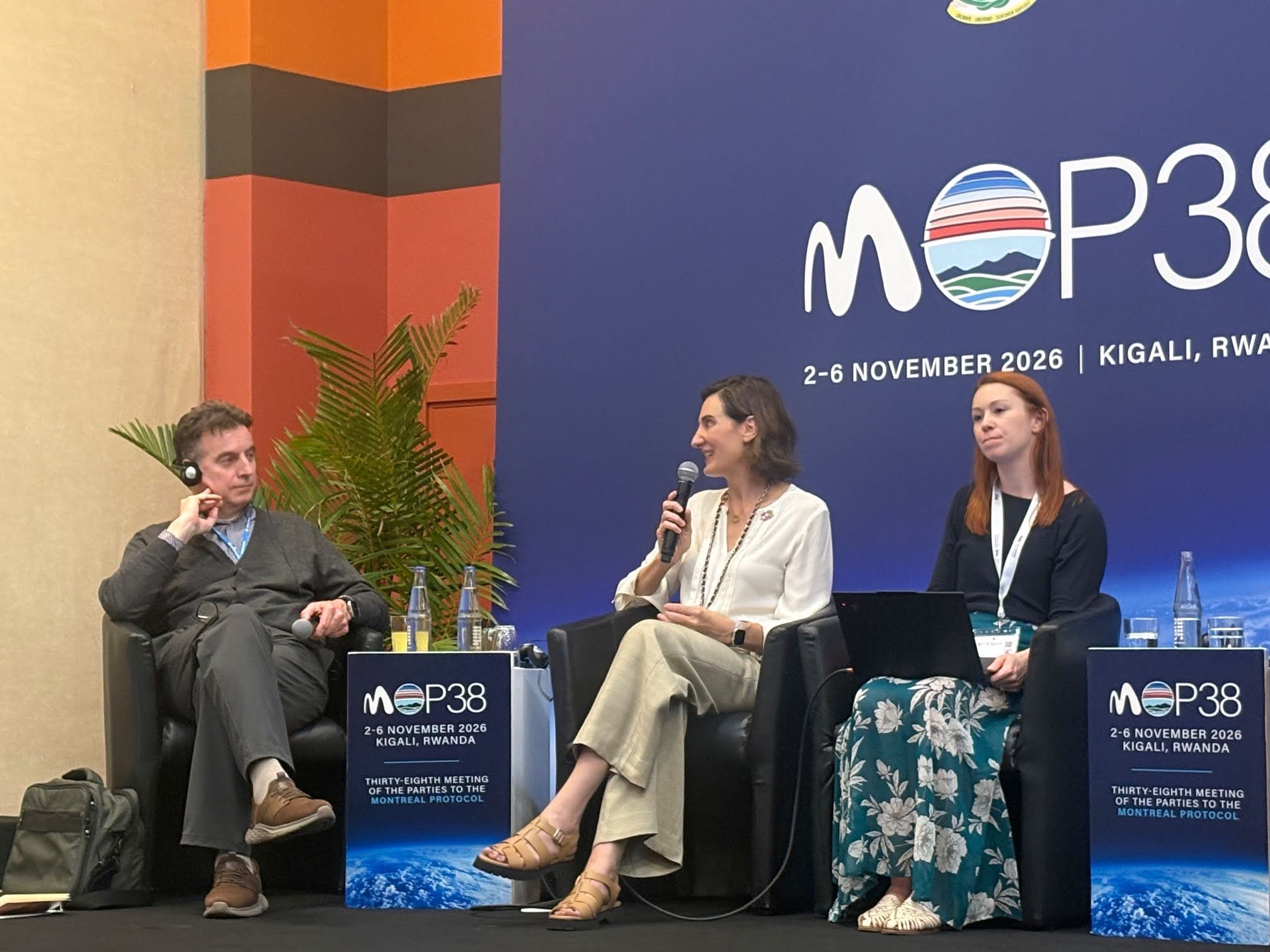
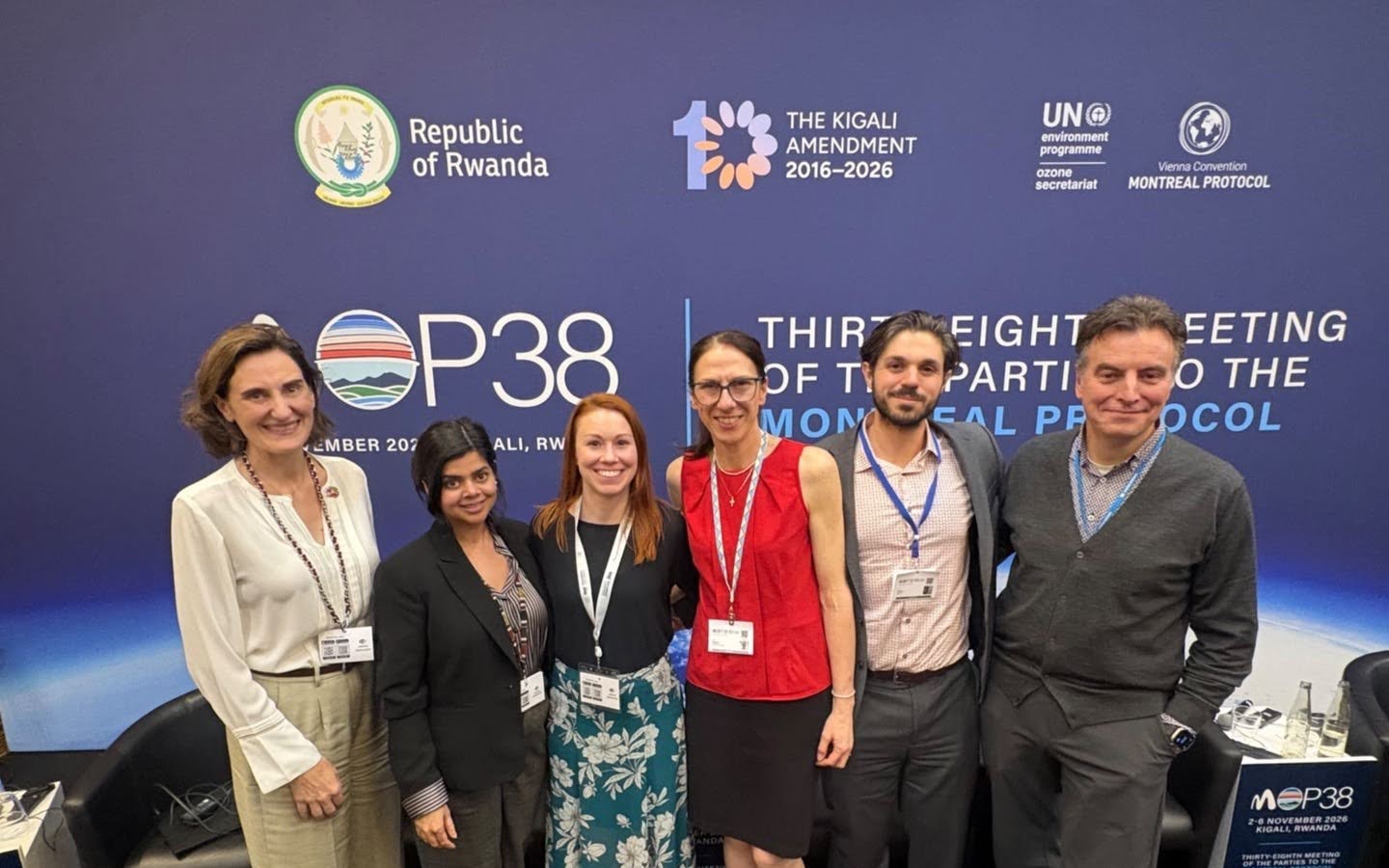
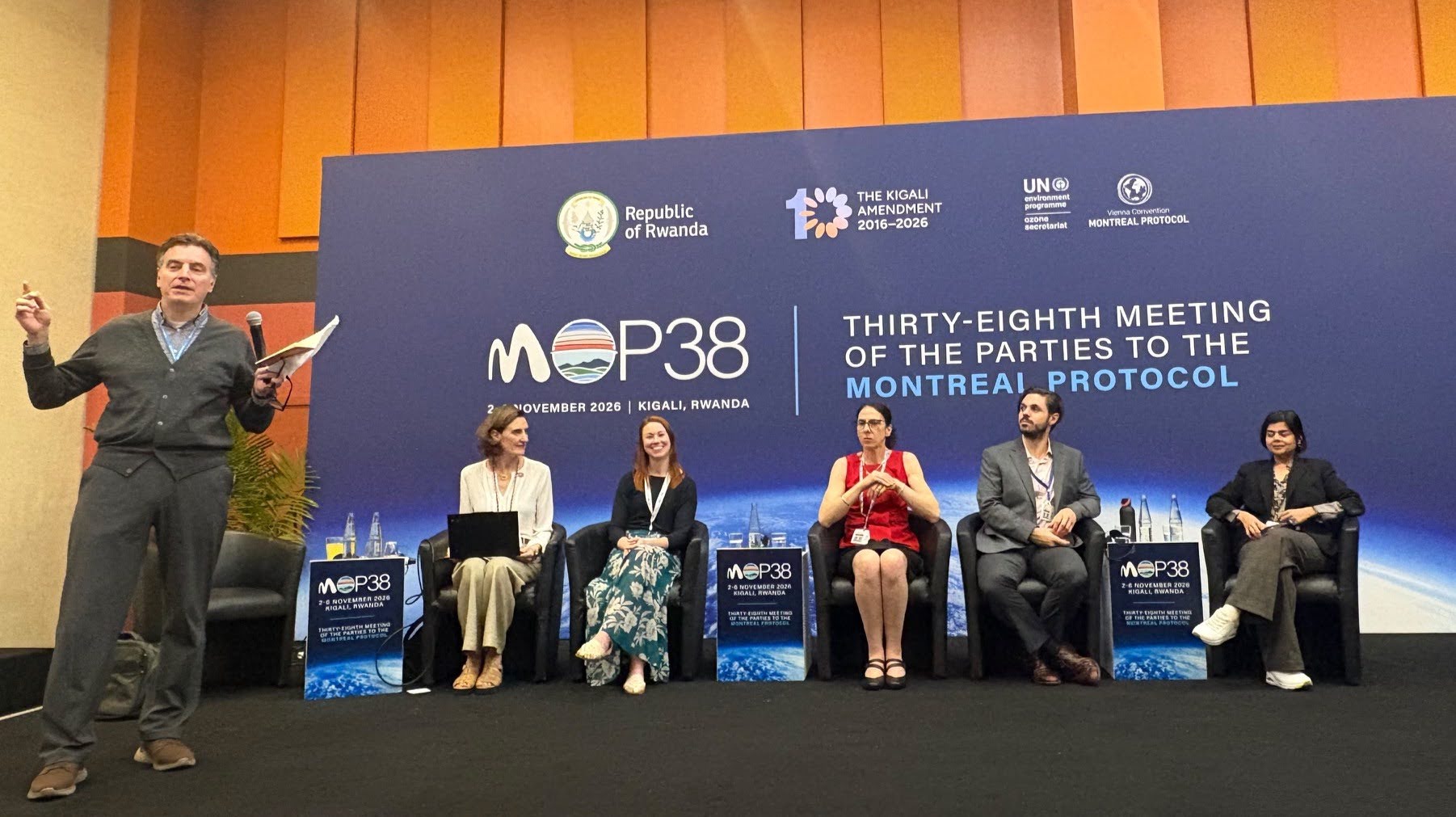
To unpack this challenge, the Carbon Containment Lab (CC Lab) and A-Gas had the pleasure of co-organizing an exciting side-event at the Montreal Protocol’s 38th Meeting of the Parties in Rwanda. This event featured speakers from A-Gas, Cascade Climate, Recoolit, the Environmental Investigation Agency (EIA), and the CC Lab. The session was facilitated by Maas Goote on behalf of the CC Lab.
Panelists of LRM Side Event at MOP38
Mapping destruction facilities: knowing what we have and where
Anastasia O’Rourke, Senior Managing Director at the CC Lab, opened with the scale of the challenge. The Protocol’s technical body, the Technology and Economic Assessment Panel (TEAP), estimates that better end-of-life recovery could avoid around 23.4 gigatonnes of carbon dioxide equivalents (CO₂e) of HFC and hydrochlorofluorocarbon (HCFC) emissions between 2025 and 2050. And in 2022, some six million tonnes of ozone-depleting substances (ODS) and HFCs, roughly 16 gigatonnes of CO₂e, sat inside working equipment worldwide. As that equipment is retired, every tonne vented or leaked is climate benefit lost.
O’Rourke’s central point was that we cannot fix a system we cannot see. Decision XXXVII/3 now asks TEAP to estimate unwanted refrigerant volumes, identify reclamation and destruction facilities, and map the barriers to moving gas across borders. Yet available lists of facilities are incomplete, and reliable data on facility capabilities, capacity, and geographic coverage remain scarce. Even where facilities are identified, their existence alone does not guarantee they are fit for purpose: what matters is whether they can destroy HFCs and blends at the required efficiency. Nor does every country need its own destruction plant. Regional coverage can be cheaper and more realistic, although transboundary movement of refrigerant wastes can be complicated by Basel Convention rules.
The CC Lab is finalizing a new and comprehensive overview of facilities worldwide, mapped by TEAP-approved technology type, to be included in the Lab’s Destruction Report, due out in January 2027.
The Lifecycle Refrigerant Management (LRM) Cost Explorer: knowing what it costs
Ali White, Program Manager at Cascade Climate, emphasized that sustained funding of lifecycle refrigerant management (LRM) requires understanding both upfront capital and ongoing operational costs. Cascade’s new LRM Cost Explorer, a free tool built on field research in five Southeast Asian countries, estimates the costs of recovery, recycling, reclamation, and destruction. Users can input data specific to their geography and scenario to achieve customized cost estimates.
The numbers point to a clear strategy: start where the refrigerant is concentrated. Using default data inputs, recovery-to-destruction is estimated to cost about $13 per kilogram for commercial HVAC equipment, against $27 for residential air conditioning units. Regional gas price also drives viability: at $5 per kilogram, the economics of reclaiming gas struggle, while at $20 per kilogram most commercial reclamation scenarios turn a profit. White also urged entities to verify where the banks of gas actually are before building anything, because dedicated facilities have too often gone dormant once their initial funding ran out and recovery volumes decreased.
The Cascade team plans to add sectors, data, and features to the tool and invites users to provide feedback.
Reclaim: turning a liability into an asset
Elvira Nigido, Group Sustainability Compliance Manager at A-Gas, brought the operator’s view. The A-Gas model—get gas, process gas, sell gas—uses revenue from the sale of virgin and reclaimed refrigerants and the creation of carbon credits to fund its LRM circular economy offerings to the market. In 2024, A-Gas avoided more than 10.8 million tonnes of CO₂e from its recovery and reclamation activities around the world.
Even so, obtaining sufficient recovery volumes to warrant investment in LRM infrastructure is the first barrier, especially in A5 countries, so it makes sense to leverage existing facilities in neighboring countries where available. A-Gas’s Singapore hub reclaims over 180 tonnes a year with room for 500 more. However, expanding recovery remains difficult to do profitably while cheap virgin refrigerant undercuts reclaimed gas, making a regional operating model and access to carbon finance important to scaling operations. Nigido’s advice: start with recovery, grow step by step in line with real volumes, and learn by doing. Quick wins exist. In South Africa, “Drop a Dispo” recovers the leftover gas from 300,000 to 400,000 disposable cylinders a year, around 308,000 tonnes of CO₂e that would otherwise be vented.
Making recovery work: technician-by-technician
Louis Potok, CEO of Recoolit, described a national-scale recovery and destruction program in Indonesia. Recoolit trains and equips technicians, rewards them for handing in gas, and sends it for destruction that adheres to TEAP standards. This work is all funded through voluntary carbon markets, including a long-term offtake agreement with Google.
The hard part, Potok stressed, is human: training alone doesn’t stick, and recovery depends on long-term relationships and hands-on support. The innovation is paying for recovery as an ongoing activity, not for one-off stockpiles. Digital tracking, with photos and GPS at every step, gives carbon buyers live proof of impact and regulators system-wide data. Still, destruction plus carbon finance is the starting point, not the destination. The goal is full circularity, with the private sector building in line with national ozone unit priorities.
From projects to systems: extended producer responsibility
Avipsa Mahapatra, Climate Director at the Environmental Investigation Agency (EIA US), underlined that the financing gap is a responsibility gap. Current systems that place the burden on the end of the supply chain—for example, on service technicians—do not stop venting because enforcement is challenging without sufficient incentives.
Under Extended Producer Responsibility (EPR) schemes, producers, importers and equipment makers instead fund collection and treatment through fees on refrigerant sales. Australia’s import levy, in place since 1993, achieves 40 to 50 percent recovery and has avoided around 21 million tonnes of CO₂e. Canada’s EPR scheme has destroyed more than 4,700 tonnes. She provided examples from several other countries and programs beyond cooling as well.
Mahapatra’s call to action was to finance the system in a sustained and sustainable way, rather than only on a project-by-project basis, with ideal EPR systems being producer-funded, government-regulated, and independently verified.
The threads that tie it together
The five speakers covered the many different angles involved. Recovery is the foundation: reclamation and destruction only work once enough gas is being collected. And finance, incentives, standards, and traceability underpin all efforts.
The economics of lifecycle refrigerant management don’t yet stand on their own, especially when cheap virgin refrigerant undercuts reclaimed gas until policy changes the equation. Carbon finance can bridge gaps now where there are no EPR schemes in place, and EPR offers a viable longer-term option. Traceability makes it all credible.
In the meantime, it is critical that we have an accurate picture of existing fit-for-purpose facilities, identify gaps in coverage, and assess the investments needed to address them. Infrastructure should be regional and sized to real volumes, which means tackling the barriers to moving gas across borders, as regulated under the Basel Convention.
The TEAP is invited to take the tools and experience showcased at this side event into account when the Panel works on its 2027 report on used and end-of-life refrigerants.