sjb-pic-1774641211.png
project

Regional Methane Abatement Framework: A Replicable Model from the San Juan Basin

Methane mitigation projects have historically been framed, communicated, and viewed differently from carbon dioxide projects, often with less emphasis on the communities and ecosystems they affect. The sidelining of these perspectives in discourse contributes to an under-recognition and undervaluation of these efforts’ importance, reducing potential investment into high-quality methane projects. To achieve large-scale methane mitigation, we must adapt approaches to fully recognize, disclose, and address all impacts—not just those focused on greenhouse gases. Beyond supporting the financing of meaningful efforts, this transparency places greater focus on the ecosystems and communities that stand to be the most affected by inaction.

Communicating methane initiatives in this manner begins with evaluating new project identification processes. Currently, efforts are largely organized around high-level methane targets (e.g., global and national) or sectoral abatement potential. These frameworks risk overlooking the granular, yet substantial, place-based emissions that affect fenceline communities and habitats on a day-to-day basis. Simultaneously, it is worth exploring the potential of methane mitigation solutions alongside more established carbon dioxide initiatives when they are co-located. Having identified these opportunities in certain landscapes, the Carbon Containment Lab (CC Lab) is developing a new, replicable framework designed to maximize co-benefits alongside significant methane reductions and, where applicable, scaled biological carbon dioxide removal efforts. Our jumping-off point? The largest methane hotspot in the United States—the San Juan Basin.

Our project aims to launch a novel site-based approach to address the full spectrum of methane emissions in the San Juan Basin. The site-based mitigation framework created through this project can be applied to additional regions in the future, thereby stimulating the deployment of high-quality abatement projects at scale. This ambitious project aims to (1) develop a portfolio strategy that pairs biological carbon sequestration with large-scale methane mitigation, informed by assessing the full array of regional methane sources; and (2) build a compelling narrative of the San Juan Basin to advance carbon market funding by highlighting the technological readiness, economics, and co-benefits of solutions. Integrating long-term biological carbon sequestration supports the development of near-term methane abatement in several ways, including by providing alternative revenue, mitigating risk for carbon credit buyers, and increasing attention and visibility for potential buyers. 
Timeline

investigation

Conduct an initial emission inventory assessment, researching regional methane emission estimates and sources. Conduct a methodology and policy analysis, constructively evaluating carbon credit methodologies for relevant methane sources and delving into existing governance structures and policies.

investigation

Conduct thorough stakeholder mapping and build relationships with Native Nations, state agencies, community groups, and project developers.

implementation

Partner with organizations to support the deployment of high-quality methane mitigation projects in the San Juan Basin by resolving critical knowledge gaps and building trust in high-integrity solutions. Support the pipeline development of new projects in the San Juan Basin by helping to build and/or support high-integrity carbon credit methodologies and other funding mechanisms.

implementation

Pilot a tool that fosters collaboration among stakeholders (e.g., marginal well owners and project developers), to advance the development of methane mitigation projects in the San Juan Basin.

implementation

Create new iterations of the tool focused on new regions.
Currently

Methane Emissions in the San Juan Basin

In 2014, a giant area of elevated methane concentration was reported over the San Juan Basin in the southwestern United States. The San Juan Basin spans four states (New Mexico, Colorado, Arizona, Utah), with a vast majority located in New Mexico. The Basin is marked by over a century of oil and natural gas production. Today, it releases over 15 million metric tons of carbon dioxide equivalent (MTCO2e) into the atmosphere each year, with emissions spanning anthropogenic and natural sources. The main methane emission sources in the Basin include a slew of abandoned/orphaned and active wells, marginal wells, abandoned and active coal mines, and many natural methane seeps. The remediation of methane escaping from these sources is crucial from climate, public health, and economic standpoints.

sjb-maps-final-1774641292.png
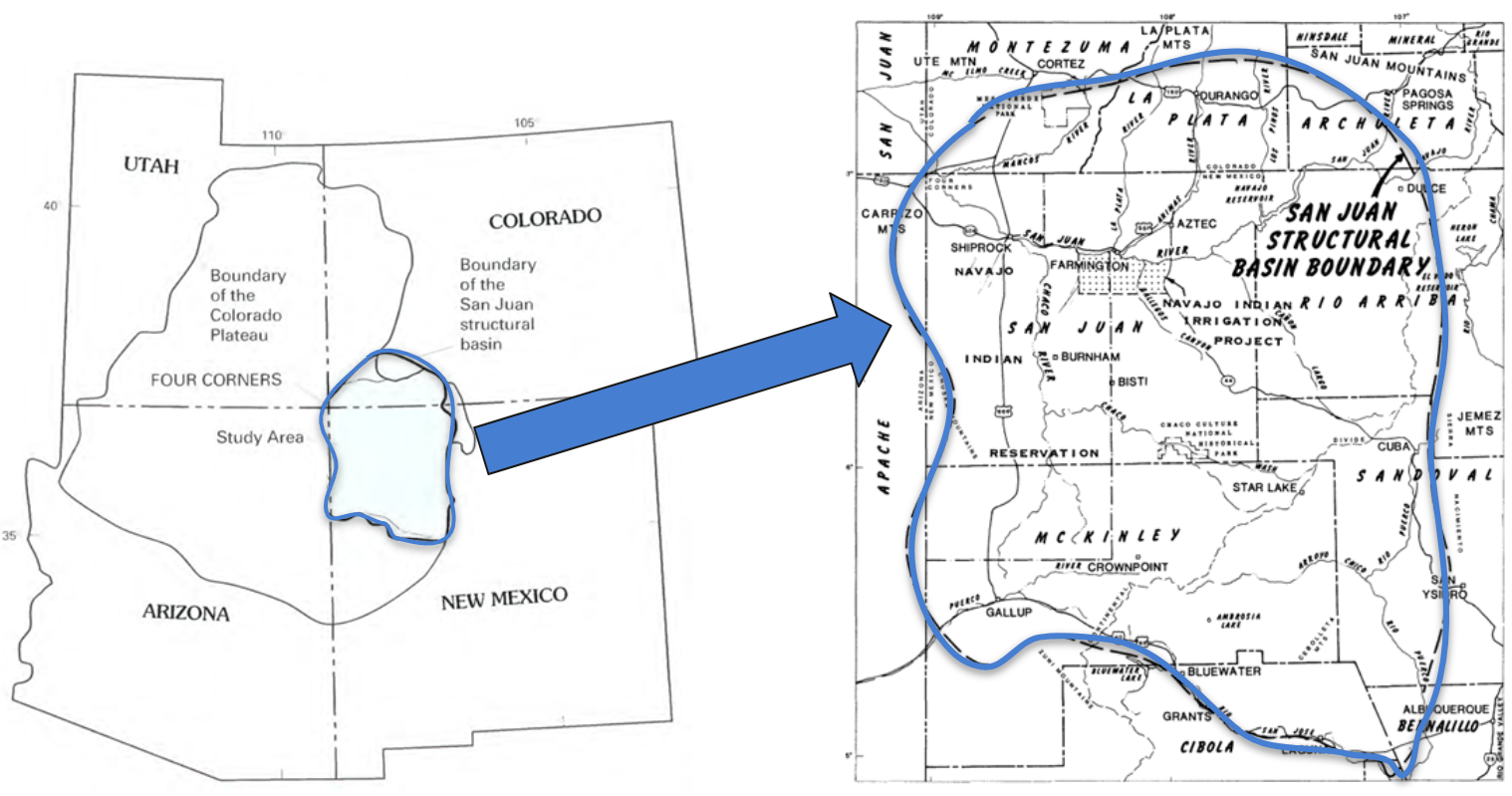
Maps of the San Juan Structural Basin. Adapted from Welder (1986), USGS, and Craigg (1987), USGS.

Abandoned/Orphaned and Marginal Wells

Oil and gas production in the Basin has been active since 1921, when the first commercially successful gas well was drilled. Since then, an estimated 40,000 wells have been drilled, of which 23,000 are classified as actively in production. This estimate implies the number of abandoned/orphaned wells is likely high, with one source claiming there are over 11,200 abandoned wells in the San Juan Basin. There have been roughly 13,000 marginal wells identified in the San Juan Basin, with thousands at risk of becoming abandoned/orphaned. The total number of these wells in the San Juan Basin is generally unknown. Both well types fall under the broader emission categories of natural gas and coalbed methane operations or oil and associated gas operations, which contribute up to 12.5 million and over 900,000 MTCO2e per year in the San Juan Basin. Although these figures do not specify contributions from these well types individually, their significant presence and deteriorating conditions suggest considerable emissions.

Orphaned and marginal wells pose a major threat to public health and the environment as they release harmful gases, including methane, hydrogen sulfide, and volatile organic compounds, contributing to air and groundwater pollution. The risk of developing neurological, respiratory, and cardiovascular conditions increases for people and wildlife living near these wells. The deteriorating conditions of these wells, caused by reduced monitoring and maintenance, amplify these health risks.

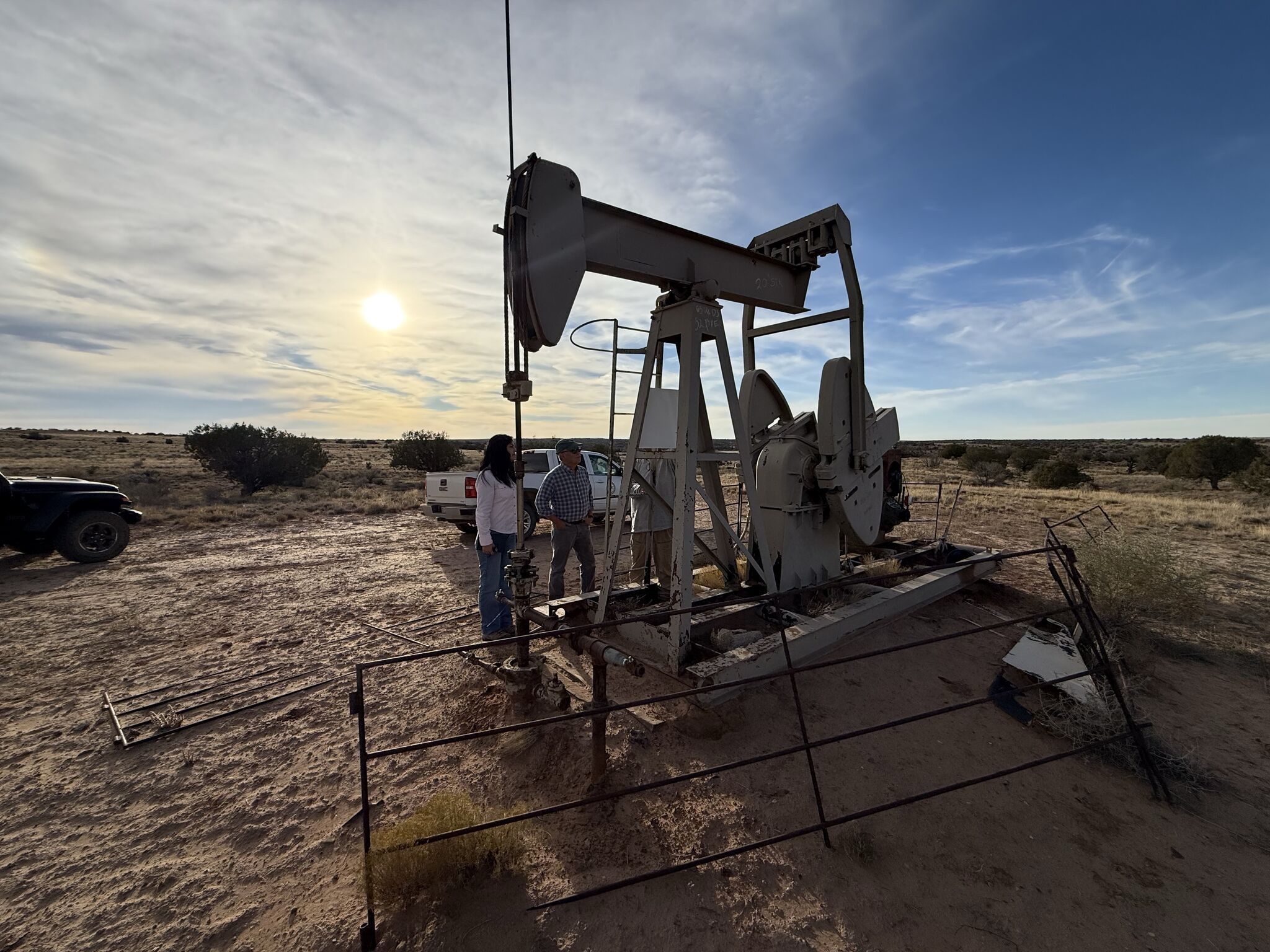
The CC Lab at an orphaned oil well site in northwestern New Mexico. CC Lab (2025).
Expand

Methane Seeps

Methane seeps, also called geological seeps, refer to the natural release of hydrocarbon-rich fluids and/or gases, which are largely methane-dominant (80 to 99 percent by volume), at the Earth’s surface. When formation pressure surpasses seal capacity, fluids and/or gases escape through permeable zones, including faults and fractures. Natural gas seepage in the San Juan Basin predominantly occurs through direct coal exposure at the Fruitland Formation outcrop and faults and fractures formed by overpressure and tectonic activity. Seepage activity has been reported along the outcrop in the Basin’s northwestern and southernmost areas, Colorado and New Mexico, respectively. These seeps vary widely in age, with some having existed for over a 100 years and others having been formed relatively recently. While the extent of seep locations is largely unknown, seep sites within Colorado’s La Plata County have been identified as having higher methane emissions compared to the rest of the outcrop belt. These seeps are estimated to release approximately 1.3 million metric tons of methane per year, with seepage increasing over the years due to coalbed methane development. The increasing seepage has raised concerns among community members, as highly combustible, explosive concentrations have been found in and near homes along the outcrop. Continuously emitting seeps pose risks to public health and the environment. They have been associated with the development of hydrogen sulfide, vegetation loss, and the contamination of domestic water wells on and off reservation land.

Coal Mines

The number of coal mines in the San Juan Basin has dwindled extensively since the start of coal mining in the late 1800s. In 2015, there were only two active coal mines, both of which were located in San Juan County. Both of these coal mines tapped into the Fruitland coal formation. Abandoned coal mines exist across McKinley, San Juan, Sandoval, and Rio Arriba Counties. There are around 400 abandoned coal mines scattered throughout the Basin. There are no estimates surrounding total methane emissions from coal mines in the San Juan Basin; however, one estimate for the San Juan coal mine alone, which closed down in 2022, is roughly 300,000 MTCO2e per year. 

graphic-for-website-1774641490.png
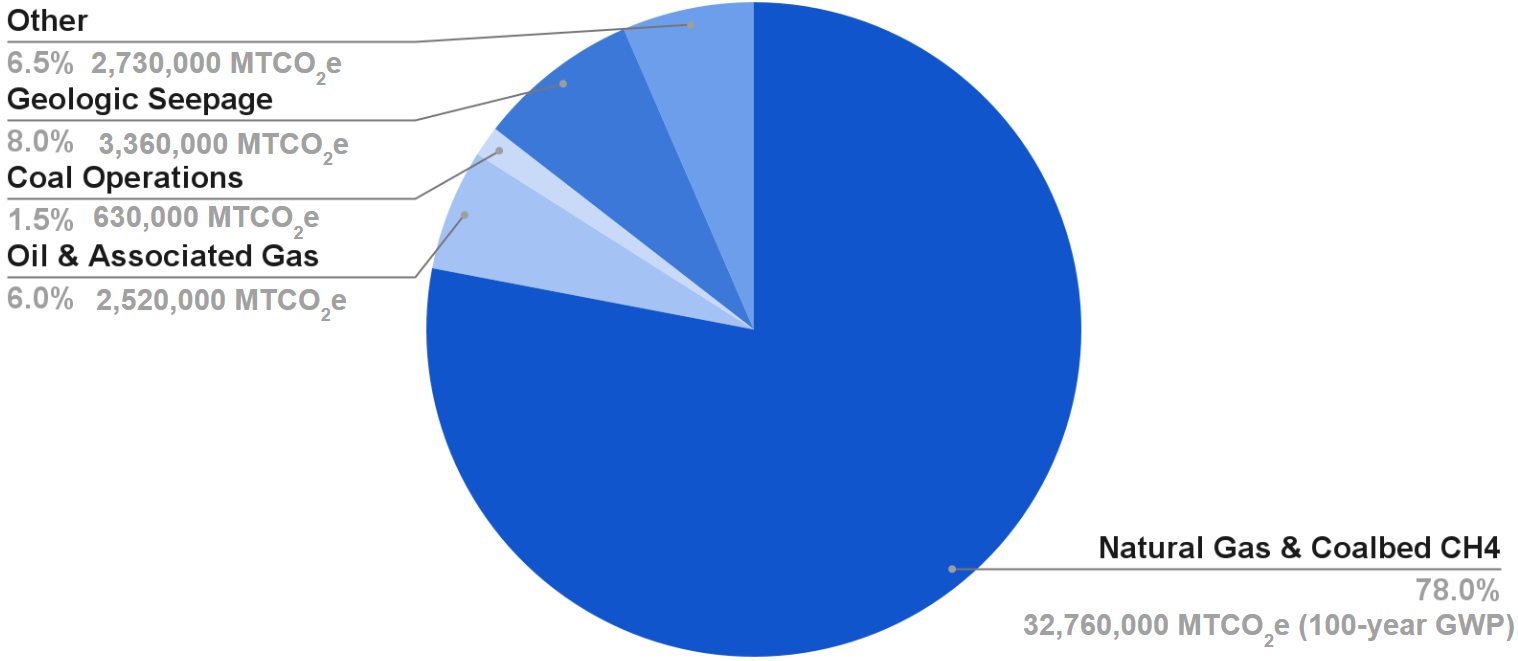
Breakdown of methane emissions by source in the San Juan Basin. MTCO2e values in gray are based on a 20-year GWP. Adapted from Pétron et al. (2020).

Applicable Solution Technologies

Well Plugging

With a Technological Readiness Level (TRL) of nine, the highest level, well plugging represents a well-established solution for the thousands of abandoned/orphaned and marginal wells that dot the San Juan Basin’s landscape. Plug and abandonment, commonly referred to as P&A, is the permanent sealing of oil and gas wells at the end of their productive lives to prevent greenhouse gas emissions and environmental contamination. The process includes assessing the well to evaluate current conditions; removing production equipment and tubing; placing cement or mechanical plugs at specific depths to isolate productive zones and aquifers; excavating and disposing of contaminated soil; and restoring the surrounding ecology. Well plugging can also incorporate real-time monitoring systems and advanced wellbore imaging tools to heighten precision. The P&A process employs well-documented sealing methods, with industry standards and best practices established by the American Petroleum Institute, Groundwater Protection Council, and National Petroleum Council.

Regenerative Thermal Oxidizers

Regenerative thermal oxidizers (RTOs) are mature technologies useful for addressing methane present at low concentrations in high-flow gas streams, typical of coal mines. RTOs destroy methane collected in ventilation air methane systems by oxidizing it, often producing excess heat that can be reused within the system or elsewhere when the methane concentration is high enough. Despite having a TRL of nine, RTOs are under-deployed at coal mines in the United States.

Terrestrial Wide-Area Capture

Technologies targeted at mitigating methane from natural seeps are few and far between, with wide-area capture being one early-stage solution. Wide area capture has involved combining methane drainage and aerobic methanotrophs to capture methane in the shallow surface to prevent its release into the atmosphere. As methane migrates naturally toward the surface, active venting via a vacuum blower removes methane from the soil and introduces oxygen to facilitate microbial methane oxidation. Wide-area methane capture from some seeps in the San Juan Basin has been tested in a pilot project. With a TRL of five, the technology has not yet realized its full methane reduction capability and faces several limitations. A key limiting factor of this technology is that it may be limited to flat areas, and natural seepage vents in the Basin are often located on uneven, elevated terrain.

Project Considerations

Source Count Uncertainty

Due to poor documentation and a lack of clear New Mexico statutory definitions for certain source terms (e.g., abandoned wells, orphaned wells), the exact numbers of abandoned/orphaned wells, marginal wells, coal mines, and methane seeps are unknown, with both well types likely having tremendous underestimations. By the time modern recordkeeping of wells and well plugging began in New Mexico, many wells had already been drilled. Resultingly, placeholder dates, which either mean a well was plugged prior to modern recordkeeping or has never been plugged, are common in existing records. With marginal wells, this recordkeeping relies on self-reporting by operators, which can be inaccurate or delayed. Similar to abandoned/orphaned wells, coal mining in the state predates modern recordkeeping, and efforts to quantify mines have been incomplete. Methane seep site identification efforts have also been incomplete, with a majority of data existing for Colorado.


Emissions Data Uncertainty

The lack of source count estimates, especially around abandoned/orphaned and marginal wells, makes estimating methane emissions even more difficult. To date, emission estimates for the San Juan Basin have been predominantly high-level, with a lack of trustworthy well-to-well estimates. The self-reported industry methane data that does exist is often based on estimates as opposed to direct measurements. This ambiguity complicates the deployment of mitigation technologies where and when they are most needed—high methane-emitting wells located near vulnerable environments.


Market and Reputational Challenges

Given their industrial nature, projects targeting these source types often lack the immediate appeal of certain carbon dioxide abatement initiatives. Beyond the technical complexities and methane measurement uncertainties associated with certain sources—which can plant hesitance among carbon credit buyers—these projects may be interpreted as assuming the responsibilities of noncompliant oil and gas companies. In reality, these projects aim to address emissions slipping through cracks in the current regulatory and compliance landscape. Rather than waiting for systems to catch up, they reduce emissions now and are meant to adapt to any landscape improvements. In turn, they prevent prolonged negative impacts on health and the environment. Nonetheless, the industrial context surrounding some of these project types presents a unique narrative challenge.


Technology Maturity Risks

Some solution technologies, such as well plugging, are already well established, while others are in earlier stages of development. In particular, solutions applicable to natural methane seeps lack the high TRLs needed to address emissions at scale in the San Juan Basin. In addition to the higher per-unit costs typically associated with emerging technologies, these solutions have not yet reached their full methane reduction potential. Widespread methane mitigation from natural methane seeps is therefore less probable in the near term compared to the Basin’s other source categories. This maturity gap indicates a greater need for solution research and development. The necessity for innovation is especially important given the hard-to-reach locations of some seeps.


High Technology Costs

Solution technologies across the Basin’s methane sources have exhibited high costs, regardless of TRL. Plugging, the highest TRL solution for abandoned/orphaned and marginal wells, has an exceptionally high cost in New Mexico, with a mean of $163,000 per well in 2024. New Mexico does not have a systematic cost-tracking system for well plugging, resulting in the absence of internal cost estimates. Resultingly, the state relies on contractor estimates, which can reach exceedingly high costs due to low price competition. Contractors may also raise these costs to address the risk that accompanies the absence of well condition information, such as internal damage. Direct methane emission measurements could provide insight into these conditions. The cost of plugging these wells increases dramatically when considering the state’s growing backlog of wells to plug. Coupled with the fact that there is no requirement to select the lowest contractor bid, plugging these wells at scale is a distant dream without alternative funding. This reality highlights the need for carbon credit financing and strategies that reduce technology costs in this region.

Partner with us

Publications